Friday, March 23, 2012

Social Conventions: The Pro's and Con's of Being a Fallen Women in Thomas Hardy's "The Ruined Maid"


In Thomas Hardy's poem "The Ruined Maid", there is a conversation between two women who were once maids together. One has gone off to do her own thing and become a "ruined" maid. There is a general sense that the woman who was still a normal maid (a country girl) had some jealousy towards O'Melia, the fallen woman. As a reader, Hardy lets you decide to what extent the country girl would go to become a ruined woman, just like her old friend, O'Melia. 

The context of the poem seems to have envy from the country girl to O'Melia. Right at the beginning of the poem you can see that she is curious where she got her clothes and wealth. O'Melia goes on to state that she had been ruined. 

In each stanza, the country girl starts off by stating how hard things were for O'Melia and how she seems to be better off now.

"You left us in tatters, without shoes or socks, (5)
Tired of digging potatoes, and spudding up docks; (6)

"Your hands were like paws then, your face blue and bleak (13)

"You used to call home-life a hag-ridden dream (17)
And you'd sigh, and you'd sock; (18)

At the end of each stanza, the ruined maid finishes it off by stating that that is how it is when you are a fallen woman.

"Yes, that's how we dress when we're ruined," said she. (8)
"Some polish is gained with one's ruin," said she. (12)
"We never do work when we're ruined," said she. (16)
"True. One's pretty lively when ruined," said she. (20)

The country girl at the end of the poem states that she wishes she had the life the ruined maid so she "could strut about Town!" (22). But for what reason? Why would someone want to become a prostitute? (this is what it means to be ruined)

Hardy seems to be showing the reader that there are advantages to being paid for sex. You get more food, better clothing, a place to stay, you just get treated better in all aspects. He isn't saying that this is the right thing to do, he is simply being honest on what prostitution gets a woman of this time. Non-sex related work, such as rural country work, is a lot harder for women to do. It is tough on them and destroys their bodies. The work is also dangerous because of the illnesses that spread and there were virtually no cure for them. 

In Thomas Hardy's "The Ruined Maid", he gives the reader the idea that O'Melia "escapes" these rural hardships and has a better life now because of it. He shows the reasons behind women being driven to prostitution. Heck, it was easy. Being paid for sex instead of doing hard work was probably a better option for many woman. But the country girl isn't exactly jealous of being a prostitute. The con's of prostitution is that you are literally selling your body. She's jealous that O'Melia has freedom from doing all the strenuous jobs that she is stuck doing and all of the pleasures she receives. The pro's that O'Melia has in doing this seems to outweigh the con's. Prostitution was a reality, as well as a smart economic choice which Hardy brings to light.

Sunday, March 18, 2012

The Fallen Woman: Does the woman still bear the title of a fallen woman after death in Thomas Hood's "The Bridge of Sighs"

In Thomas Hood's "The Bridge of Sighs" it brings up the question on whether one can continue to call a "fallen woman" a fallen women after death. Is she free of such a label? Did she kill herself to rid herself of such a name? Of course, I'm getting ahead of myself.

The context of this poem is rather tragic and told from either an omniscient voice or a person who found the girl speaking to someone who's taking care of the body. The speaker is very careful about the girl, urging the other individual to handle her as delicately as possible. He says in lines 13-14 to the other character to "Take her up instantly/ Loving, not loathing." She may be a dead prostitute, just because she is a prostitute it gives no reason for anyone to treat her uncivilly. The speaker's respect for the dead woman continues throughout the rest of the poem.

Touch her not scornfully; 15
Think of her mournfully,
Gently and humanly;
Not of the stains of her,
All that remains of her
Now is pure womanly. 20

From lines 15-20 the speaker is reminding the person/reader to not think of her as a prostitute. He repeats his early sentiment to take care of her with love because after death she became pure. Yes, if she were still alive one wouldn't think of using kind manners to a prostitute, but the speaker kindly requests for us to think "Not the of the stains of her,"(19) but as any pure woman who could have died that night. That life she lived as an unclean woman is over. Now that she is dead there is no point to continue with such bad behavior. All dead person's deserve respect.

Hood doesn't put to bed the thought of seeing the fallen woman as a new kind of person than being recognized for her old ways. In lines 21-35 the speaker continues to defend the woman's corpse, or rather her soul.

Make no deep scrutiny 21
Into her mutiny
Rash and undutiful:
Past all dishonour,
Death has left on her
Only the beautiful. 26

At the 5th stanza the speaker against reminds the reader and to whomever he's talking to to not judge her for the mistakes she's made in her past life. He acknowledges that it wasn't a life honor and colour and beauty, but it's all over now and she's dead– that life is gone. She's a beautiful person, looking peaceful almost because she doesn't have to live on that burden any longer, knowing she's a prostitute in a society that really didn't care for her.

Nearing the end of the 7th stanza to the 8th stanza he begins to wonder who this woman was before her death, before she ever became a prostitute. He detaches her from her former fallen life and enters a series of thoughts of where she came from. Who were her family members? He gave the woman a life prior to her death, who was she loved? With lines 40-42 he asks "was there a dearer one / still, and a nearer one / yet, than all other?" The question of whether or not she was loved at all by someone who knew her, who was probably near by somewhere, reminds us that she was a human being. Just because she was a ruined woman doesn't mean she still didn't have the desires for love by a single person. That one person would always be more significant than any of the patron's she ever had. She was a real person, a real woman.

Unfortunately the life of a fallen woman was too tiring for this woman. The later descriptions Hood uses of the type of setting it was that she killed herself in has the reader feeling sorry for her. She died in the cold winter month of March because she was exhausted of "life's history," the misery every day has brought lead her to be "glad to death's mystery," (68); she was happy to embrace death. In lines 69-71 she was "Swift to be hurl'd – / Anywhere, anywhere / Out of the world!" Either the speaker is saying she would rather be out of this world or if it was Hood himself, one cannot know for sure, but what is clear is that she tired of living this life and wanted to leave this world that was so cruel to a woman in her position. Why wouldn't she dive into the dark river? It's as if she pass on to a new world when she hit the water.

In she plunged boldly— 72
No matter how coldly
The rough river ran— 74

As she drowns in the water, is it possible that she cleansed herself of her sins of a prostitute to cross over into the after life as the "pure woman" Hood hints at? This question may come off as a bit odd because suicide is a sin itself, but the representation of emerging her body through the water almost reminds one of a baptism taking place. She purified her soul so she may enter a world that's more deserving to live in.

Owning her weakness, 103
Her evil behaviour,
And leaving, with meekness,
Her sins to her Saviour! 106

Towards the end of the poem the speaker suggest to us that before the woman ended her life she forgave herself of the life she led before. She knew that the life she led was "evil" and so as she quietly left her past life she carried her sins to the after life to place them before God (the Saviour from line 106). When I read this last stanza I thought to myself that she went before God with the strength in knowing she has sinned before and hopes for a new beginning in the afterlife, in Heaven. She left her worldly body because it was tarnished and everyone knew this of her. In Heaven she could be forgiven for her past life and start anew at a place where she can feel loved.

To read the rest of the poem by Thomas Hood, visit: http://www.poemhunter.com/poem/the-bridge-of-sighs/

Wednesday, March 14, 2012

Sex Ed: Sexual Politics within The Lady of Shalott


We all remember the awkward moments of sexual education class, when we were still too immature to tale any of it seriously. Girls would blush, boys would laugh hysterically, and teachers would be frustrated to the point of pulling the hair straight out of their own heads. And we also can easily remember the myths our parents and superiors would fill our head with in order to scare us away from having relations with one another. One of the most common myths, and most laughable, is:

“ If you have sex, you will die.”

Now of course, we know this isn’t true., either by experience, or the simple logic that babies do not come from storks, and we are in fact, here. But what we may not know is how long this myth has been in circulation, and where it originates. However, we can trace it as far back as the 19th century, within the lines of Tennyson’s “Lady of Shalott.”

The reading of poetry, we have learned, was a very common practice in the 19th century. And, considering they didn’t have televisions back then, the infamous They needed a way to get their message out to the masses. Poetry, it seems, was an excellent method.

Of course, many people read Tennyson’s poem as being center around the idea of the artist and life, and the relationship between the two. The two different symbols being represented by Shalott and the “many-towered Camelot.”  It would seem that the question is simply answered, being that the two can not coincide, and is represented by the death of the artist; the embowered Lady of Shalott.  Now, dear reader, you may be asking yourself where I get the idea of sex, and therefore, the idea of the fair Lady dying because of it.  My answer, is this.


She left the web, she left the loom,
She made three paces thro' the room,
She saw the water-lily bloom,
She saw the helmet and the plume,
She look'd down to Camelot.
Out flew the web and floated wide;
The mirror crack'd from side to side;
"The curse is come upon me," cried 

All through parts I and II, the Lady of  Shalott is happy in the tower. Her colors are “gay,“ her songs are “cheery.” She is seemingly content with her curse. She does not know where it came from, but that she can only view the world from the mirror, not directly. However, one day, she sees Lancelot ride by on his way to Camelot. So struck is she by him, that she goes to the window to look upon him herself, breaking the mirror, and brining the full curse upon her. Her feminine desire is what causes the curse to come at her full force, ending her life. Because we know that she is aware of the details of the curse, we can easily infer that her desire is strong enough to even be called lust.

So in the end, it is her lust, that ends her life.  We can take this as social commentary, about how the downfall of a woman is the loss of her virtue. Simply put:

Lady Sees Man and Swoonsà Lady’s Lust Brings Upon Curseà Lady Dies In Search Of Lust Worthy Man.

Monday, March 12, 2012

Ozymadias...Percy Shelley


Percy Shelley’s poem Ozymadias is very emblematic of Romanticism in literature. It is rich in imagery and serves as an allegory for the meaninglessness of political ambition. The poem starts with the description of the ‘traveller from an antique land’:

[2]Two vast and trunkless legs of stone
[3]Stand in the desert. Near them on the sand,
[4]Half sunk, a shattered visage lies…

The imagery in these lines is melancholic because a statue, symbol of fallen glory is being described – lifeless, distant, and with a shattered visage. The tone of the sonnet continues to be despairing in the lines that follow, and the talent of the sculptor who was able to capture the character of Ozymandias is also described:

[5]And wrinkled lip and sneer of cold command
[6]Tell that its sculptor well those passions read
[7]Which yet survive, stamped on these lifeless things,
[8]The hand that mocked them and the heart that fed.

Albeit the tone is melancholic, in [7] and [8] Shelley writes how Ozymandias’ passions still survive because of the talent of the sculptor. It sounds paradoxical to survive in a lifeless form, but the shattered visage still lies in the desert. 

In the last five lines of the sonnet, one can see in them the elusiveness of the concepts of time and memory. They epitomize the irrelevance of the thirst for power because the words on the pedestal are gloriously narcissistic, but the statue is surrounded by nothing beside it.

[10]`My name is Ozymandias, King of Kings:
[11]Look on my works, ye mighty, and despair!'
[12]Nothing beside remains. Round the decay
[13]Of that colossal wreck, boundless and bare,
[14]The lone and level sands stretch far away".

Although the poets were part of different literary movements, the ending reminded me of the concept behind Frost’s Nothing Gold Can Stay. According to PBS, that was one of the nicknames for Ramses II, “one of the most prolific builders of ancient Egypt (Clark & Tyson, Explore Ancient Egypt).” Ramses II was important for Egypt, the ‘gold,’ but it did not stay and in turn, now there is the colossal wreck that Shelley describes.

Friday, March 9, 2012

Innocence in William Blake's "The Little Black Boy"

Innocence in William Blake's "The Little Black Boy"


This poem, published in Songs of Innocence, is the voice of a black child and how he came to know himself and God. The poem is built upon imagery of lightness and darkness and you can see this in the first stanza.

My mother bore me in the southern wild, (1)
And I am black, but O! my soul is white. (2)
White as an angel is the English child: (3)
But I am black as if bereav'd of light. (4)

There is contrast between the black boy's skin and his believing that his soul is white, proving his problem of not being able to understand what is actually the truth, or in other words, innocence. He has yet been exposed the harsh realities of the world. 

His mother symbolizes the selfless love that the young child longs for, as well as acceptance. Darkness comes into play yet again.

For when our souls have learn'd the heat to bear (17)
The cloud will vanish we shall hear his voice (18)
Saying "come out from the grove my love & care, (19)
And round my golden tent like lambs rejoice." (20)

She tells the boy that their dark skin is nothing but a temporary appearance that means nothing later on in the eternal life. Skin is only an earthly feature in which God does not care about, according to the mother. They will all be equals once they reach heaven.

The black boy uses his mother's words and goes on to speak to the white boy about the situation at hand. The black boy explains to the white friend that they are one in the same, and neither of them will be free until they are released from the limitations of the physical world. "When I from black and he from white cloud free,(23) And round the tent of God like lambs we joy:(24). 

He goes on to say that he will shade his friend from the heat until he can take it himself, which implies that his dark skin has prepared him for heaven better than the white boy. 

Ill shade him from the heat till he can bear. (25)
To lean in joy upon our fathers knee (26)
And then Ill stand and stroke his silver hair. (27)
And be like him and he will then love me. (28)

This last stanza shows the black boys' admiration and regard for the white friend. To the reader who doesn't have innocence like the black child does, it is easy to see that he seems oblivious or naive to the realities of oppression and racism (or again; innocence). In the image at the top of the page, the black boy is behind the white boy who is in front of God, which sort of shows the reader that Blake was expressing the idea that the whites come first. The black boy drives to be like the white boy because he thinks it is the only way God will love him. Although the reader knows that this is not true, we can see that the black boy does not. We can only hope that when he one day figures it all out he shows the same kind of compassion and concern for his white friend and all other races. This complicated matter isn't for children to think about, but Blake gives the reader a look at what it might look like.

For further info on the poem and how critics have viewed it from 1924 through 1995, visit http://www.english.uga.edu/wblake/SONGS/9/9kozlows.bib.html

Thursday, March 8, 2012

Slaves to Servants: What it means to Mary Prince in "The History of Mary Prince"

Slaves to Servants: What it means to Mary Prince in "The History of Mary Prince"


Mary Prince was a Bermudian woman who was very unfortunate and born into slavery. Her story, "The History of Mary Prince" was the first account of the life of a slave to be published. It is written in first-person, which gives the reader a different feeling than if it were written by someone else. The grammar and syntax are all well written and this is because it was actually written down by Susanna Strickland. Readers might think because of this that the story has been changed in some way or things left out but that is up to the reader to decide that. It is easily believable to think that these things Mary Prince talks about are true because of the great detail she explains them.

"I have been a slave myself-I know what slaves feel-I can tell by myself what other slaves feel, and by what they have told me. The man that says slaves be quite happy in slavery that they don't want to be free-that man is either ignorant of a lying person> i never heard a slave say so. I never heard a Buckra man say so, till I heard tell of it in England. Such people ought to be ashamed of themselves. They can't do without slaves they say. What's the reason they can't do without slaves as well as in England? No slaves here-no whips-no stocks-no punishment, except for wicked people. They hire servants in England;" (279)

Whats the difference between a slave and a servant? Most people can probably answer this themselves. Servants get paid and voluntarily complete their tasks whereas slaves don't get paid and are forced to complete harsh tasks. On page 297 of our text, written by an anonymous writer on Thoughts on the Slavery of Negroes, as it Affects the British Colonies in the West Indies (297), he/she states that Africans have always been represented as perfidious, lazy, lascivious, faithless people who are thieves, without morals, and without any just notion of any one religious duty. On the contrary, Mary Prince states that they don't mind hard work. All they want is proper treatment and wages like the English servants do. (279) Liberty is something they long for, but their masters will not give it to them. They make them work day and night, hour after hour, sick or abused, never receiving a break. Prince was constantly beaten by her owners and their was nothing she could do about it. She would be stripped naked, hung up by the wrists and beaten with cow skin until her body was raw with gashes. "Yet there was nothing very remarkable in this; for it might serve as a sample of the common usage of the slaves on that horrible island." (271)

That same person mentioned above stated that if they could show that slaves are happy and better off than the low orders of people in Britain, than slavery can be justified. He states that when the Europeans first went to Africa it was a barbaric state and taking these people and giving them a place to live is helping them out. Helping them out is the complete opposite of what was going on.

It's not helping them out when they don't care about whether or not they lived or died (269). Another poem our class had read entitled "The Sorrows of Yamba", details the life of a slave woman who travels with her daughter. Her daughter had died and the mother was happy that she did because she wouldn't have to be beaten or starved or go through any of the hardships they went through. For someone to long for death and be glad that their child is dead shows the atrocities the slaves were going through. 

Mary Prince's story is believable because she credits some slave owners for being good owners. It makes it compelling to see that she didn't equate all the slave owners as the same, making it more convincing. Throughout the story she was dehumanized, raped and beaten. As she speaks for all slaves because she has been through the worst of it, they want to have what the servants do in England. If they aren't liked in England, they get sent away and the owners cannot beat them. Prince states that they are far better off than slaves. "If they get a bad master, they give warning and go hire to another. They have their liberty. That's just what we want." (279) 


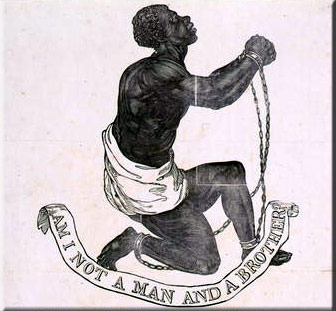
The above picture, "Am I not a man and a brother?" compels its audiences. It uses pathos, or emotional appeal, to get its point across. It fits perfectly with Mary Prince's story. From what we know now, growing up in the past 2 decades, everything to do with slavery is wrong. Yes, we know they are human beings and are our brothers and sisters but back in that time, with the mindset of a slave owner, they wouldn't give the slaves any justice. Prince, of course like many others, wanted her freedom, but would settle for the rights and proper treatment that the servants in England were receiving. Their owners wanted nothing to do with this and would beat them at the thought of doing so.

Her story opened the gate for other narratives to follow.  Eventually, people started to become aware of slavery and its horrid characteristics to go along with it and it was abolished in Britain in 1833 under the Slavery Abolition Act. For more information on the abolition of slavery, go to http://www.nationalarchives.gov.uk/slavery/.

To hear the voice of Mary Prince (or an actor of her character) read aloud passages from the biography, go to http://abolition.e2bn.org/people_37.html

Tuesday, February 28, 2012

Poetry Through the Authors' Eyes

I know I'm not the only one to have struggled with Blake or Wordsworth - and I certainly won't be the last - but while reading a few of their poems, I found it immensely helpful to have an image that somewhat depicted what they were writing about alongside the text. The images I pulled up on each poem added vivid detail to their descriptions (I'm a bit of a visual learner, myself) and led me to a whole different level of understanding while perusing their works.

I would just like to share a few of these pictures for anyone who wanted to read through Blake's "The Chimney Sweeper" (both Songs of Innocence and Songs of Experience versions).
This picture gives a little more feeling to Songs of Innocence's "The Chimney Sweeper." Personally, I saw this and pictured it to be the embodiment of Tom Dacre; in the face of a hard life and certain death, the boy in this picture still has a smile on his face. In "The Chimney Sweeper," Tom was spoken to by an angel who told him to do be a good boy and (implicitly) do his job without complaint. The angel said when he passed on, he'd have God for his father and never be sad.

This picture portrays a completely different spin on chimney sweeps. It gives us a view of chimney sweeps close to Blake's "The Chimney Sweeper" in Songs of Experience. In this picture, we're shown how sad and woeful the profession of chimney sweeping was. Note how not a single boy is smiling in the picture. Side by side with Experiences "The Chimney Sweeper," it loans a powerful image to Blake's words; it's as if he's describing any one of these boy's lives. 

An interesting article about the life of chimney sweepers can be found here.

-----------------------------------------------------------------------------------------------

When reading through Wordsworth's poetry, I definitely had a desire to see with my own eyes what he was describing. I did some searching and pulled up a few images to go alongside with "Lines Written A Few Miles Above Tintern Abbey" and "Composed Upon Westminster Bridge, Sept. 3, 1803."

This photo is actually a picture of Tintern Abbey from the hills a few miles out - an almost exact representation of what I believe Wordsworth saw and wrote about. It's just a nice accompaniment to have alongside the poem.


Westminster Bridge is a wide bridge that crosses the Thames, connecting Westminster and Lambeth. This is a view of Parliament from the bridge - undoubtedly the part of London Wordsworth was looking back upon - and we can see that it is an early morning, before the bustle of life awakens. Try picturing this to be Wordsworth's picture, and immediately after he took this, he began to write. It's a cool thought.

In any regard, I highly advise trying to find images to accompany many of the Romantic era poems. It's helpful to try to see what the authors were seeing when they wrote, and really leads to a better understanding of the poetry.